Lion's Mane (Hericium erinaceus) has become one of the world's most sought-after functional mushrooms due to its association with cognitive health. While beta-glucans are commonly discussed, increasing attention is being given to a unique class of compounds known as Hericenones. Found within the fruiting body of Lion's Mane, Hericenones have emerged as important markers of therapeutic efficacy and quality.
Overview
- Hericenones are species-specific bioactive compounds found exclusively in the fruiting bodies of Lion's Mane (Hericium erinaceus). Unlike beta-glucans, which occur across many mushroom species, Hericenones are unique markers of Lion's Mane authenticity and quality.
- If you're a brand, you should be asking for Hericenone data from your supplier. Learn about how Bioshroom is testing Hericenones in our Lion's Mane in our article Lions Mane Testing: Why We Spent a Year Learning How to Measure Hericenones.
- Hericenones C, D and F currently have the strongest biological evidence, demonstrating neurotrophic activity in PC12 neuronal cell models. Studies have shown that certain Hericenones can promote neurite outgrowth and neuronal differentiation, both commonly used indicators of neurotrophic activity.
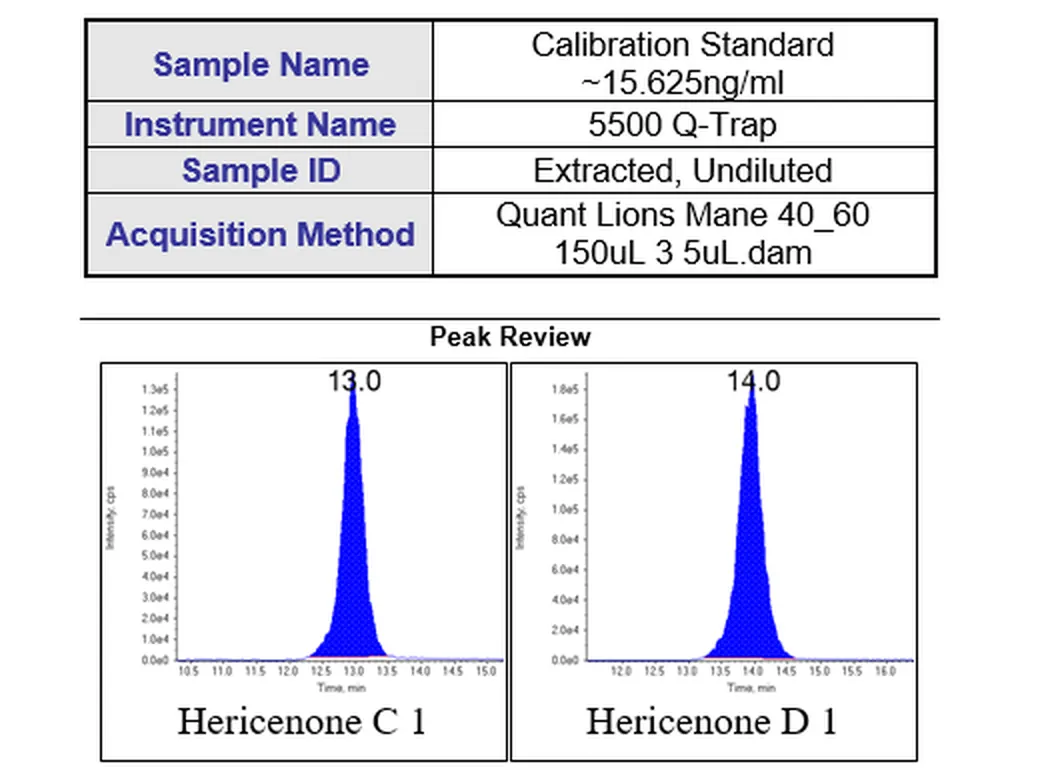
- Hericenones C and D are emerging as important quality markers for Lion's Mane fruiting body ingredients and are increasingly being quantified through third-party laboratory testing.
- Hericenone testing enables manufacturers and consumers to verify species-specific Lion's Mane bioactives, improve transparency, and differentiate products based on measurable compounds rather than marketing claims alone.
- As the functional mushroom industry matures, Hericenones are becoming one of the most important emerging markers of Lion's Mane quality, standardisation, and product differentiation.¹
What Are Hericenones?
Hericenones are a class of naturally occurring, alcohol-soluble aromatic compounds found exclusively in the fruiting body of the Lion's Mane mushroom (Hericium erinaceus). They belong to a group of bioactive secondary metabolites known as meroterpenoids, characterized by an aromatic orsellinic acid core linked to a terpenoid side chain, typically geranyl-derived.
Among the various meroterpenoids identified in Lion's Mane, Hericenones are the best known and have attracted significant scientific interest due to their potential neurotrophic activity and their uniqueness to the fruiting body.
Unlike beta-glucans, which occur across many medicinal mushroom species, Hericenones are considered species-specific compounds strongly associated with Lion's Mane. This makes them particularly relevant for manufacturers, formulators, and consumers seeking authentic Lion's Mane bioactives.
Why Are Hericenones Important?
One of the reasons Lion's Mane has attracted scientific interest is its potential neurotrophic activity. Neurotrophic compounds are substances that support the growth and maintenance of neurons.
A growing body of research has focused on Hericenones because of their potential ability to influence pathways associated with nerve growth, neuroprotection, and cognitive function.¹²
For ingredient manufacturers, Hericenones also provide a measurable indicator of product quality. Rather than relying on blunt quality proxies like beta glucans or extraction ratios, Hericenone testing allows laboratories to quantify compounds unique to Lion's Mane fruiting bodies.
What Research Has Been Done on Hericenones?
A recent scientific review, Hericenones From Hericium erinaceus (Bull.) Pers: A Scoping Review of Structural Diversity and Health Benefits, provides one of the most comprehensive summaries of Hericenone research currently available.¹
The review concluded that biological evidence is strongest for a subset of Hericenones, while many others have primarily been studied from a chemical and structural perspective.¹³
Hericenone A
- One of the earliest identified Hericenones isolated from Lion's Mane fruiting bodies.
- Primarily known through chemical isolation and structural characterization studies.
- Limited biological evaluation has been reported.¹
Hericenone B
- Structurally related to Hericenone A.
- Identified and characterized from Lion's Mane fruiting bodies.
- Research has focused largely on chemical structure rather than biological activity.¹
Hericenone C research findings
Among the most extensively researched Hericenones.
- Investigated in PC12 neuronal cell models.
- Demonstrated promotion of neurite outgrowth, a commonly used marker of neurotrophic activity.
- Evaluated in studies examining NGF-related biological pathways.
- Frequently used as a marker compound in commercial Lion's Mane testing.¹²
Hericenone D research findings
- Evaluated in neuronal cell models associated with NGF activity.
- Demonstrated increased neurite extension and cellular differentiation in PC12 cells.
- Considered one of the most commercially relevant Hericenones due to both prevalence and biological significance.¹²
Hericenone E
- Identified and structurally characterized from fruiting bodies.
- Limited biological data currently available.
- Existing evidence is primarily chemical in nature.¹
Hericenone F research findings
- Evaluated in NGF-related cellular assays.
- Demonstrated promotion of neurite outgrowth in PC12 cells.
- Represents one of the strongest areas of biological evidence within the Hericenone family.¹²
Hericenone G
- Isolated and structurally characterized from Lion's Mane fruiting bodies.
- Limited biological activity data currently available.¹
Hericenone H
- Identified as part of the broader Hericenone family.
- Current evidence primarily relates to chemical characterization.
- Little biological evaluation has been reported.¹
New Discoveries: Additional Hericenone Analogues
Recent work by Wang et al. expanded scientific understanding of Lion's Mane bioactives beyond the traditionally recognised Hericenones A-H.³
Key findings include:
- Discovery of previously overlooked Hericenone-related compounds.
- Identification of biosynthetic intermediates involved in Hericenone production.
- Evidence supporting a more complex biosynthetic pathway than previously understood.
- Improved understanding of how Lion's Mane produces species-specific bioactives.³
Key Takeaways on Hericenones
Current evidence suggests that Hericenones C, D and F possess the strongest biological support, particularly from in vitro studies using PC12 neuronal cell models.¹²
These studies demonstrated:
- Neurite outgrowth
- Neuronal differentiation
- Neurotrophic activity associated with NGF-related pathways¹²
Most other Hericenones have primarily been investigated through chemical and structural studies.
It is important to note that much of the broader evidence supporting Lion's Mane has been generated using whole mushroom preparations, extracts, or enriched fractions rather than isolated Hericenones. Further animal and human research remains necessary.¹²
Why Third-Party Hericenone Testing Matters
As the functional mushroom industry matures, there will naturally be a convergence towards label transparency and species specific bioactive labelling. The same thing happened in numerous other industries around the world.
Historically, Lion's Mane products have focused on beta-glucan testing. While beta-glucans remain an important quality marker, they do not provide a complete picture of Lion's Mane's unique bioactive profile.
Testing for Hericenones enables manufacturers and consumers to:
- Verify species-specific Lion's Mane compounds
- Confirm fruiting body authenticity
- Improve ingredient transparency
- Differentiate products based on measurable bioactive content
- Support more informed purchasing decisions
What Is the Future of Hericenone Testing?
Hericenones are becoming one of the most important bioactive markers in Lion's Mane mushroom ingredients.
As scientific understanding grows and analytical methods improve, Hericenone testing is expected to play an increasingly important role in:
- Functional mushroom quality control
- Ingredient standardisation
- Product differentiation
- Consumer transparency
If you're a brand, you should be asking for Hericenone data from your supplier. Learn about how Bioshroom is testing Hericenones in our Lion's Mane in our article Lions Mane Testing: Why We Spent a Year Learning How to Measure Hericenones.
Frequently Asked Questions
What are Hericenones?
Hericenones are aromatic bioactive compounds found primarily in the fruiting body of Lion's Mane mushroom (Hericium erinaceus). They are considered species-specific compounds unique to Lion's Mane.¹
Which Hericenones are most studied?
Hericenones C, D and F currently have the strongest biological evidence, particularly from cell culture studies investigating neurotrophic activity.¹²
Are Hericenones the same as beta-glucans?
No. Beta-glucans are polysaccharides found across many mushroom species, while Hericenones are species-specific aromatic compounds associated with Lion's Mane fruiting bodies.¹
Why test for Hericenones?
Hericenone testing helps verify the presence of Lion's Mane-specific bioactives and provides a more complete picture of ingredient quality than beta-glucan testing alone.
References
- Krystek, M. et al. (2025) Hericenones From Hericium erinaceus (Bull.) Pers.: A Scoping Review of Structural Diversity and Health Benefits. Nutrients. Available at: https://pmc.ncbi.nlm.nih.gov/articles/PMC13420232/
- Szućko-Kociuba, I., Trzeciak-Ryczek, A., Kupnicka, P. and Chlubek, D. (2023) 'Neurotrophic and Neuroprotective Effects of Hericium erinaceus', International Journal of Molecular Sciences, 24(21), 15960. Available at: https://pmc.ncbi.nlm.nih.gov/articles/PMC10650066/
- Wang, J., Wu, J., Yamaguchi, R., Nagai, K., Liu, C., Choi, J.-H., Hirai, H., Xie, X., Kobayashi, S. and Kawagishi, H. (2025) 'Uncovering Hericenones from the Fruiting Bodies of Hericium erinaceus through Interdisciplinary Collaboration', Journal of Natural Products, 88(1), pp. 80-85. Available at: https://doi.org/10.1021/acs.jnatprod.4c01018.